

MD&A · 2025
In this section4 topics
Overview of Operations
Overview of Operations
In 2025, the international logistics industry continued to face volatility from global economic factors and geopolitical situations, particularly the adjustment of global freight rates after a significant increase in 2024 due to unrest in the Middle East and the rerouting of vessels through the Red Sea. As the situation began to ease in 2025, freight rates gradually adjusted to levels closer to normal. This led to a tendency for revenue among logistics operators, especially in the sea freight business, to decrease compared to the high revenue base of the previous year.
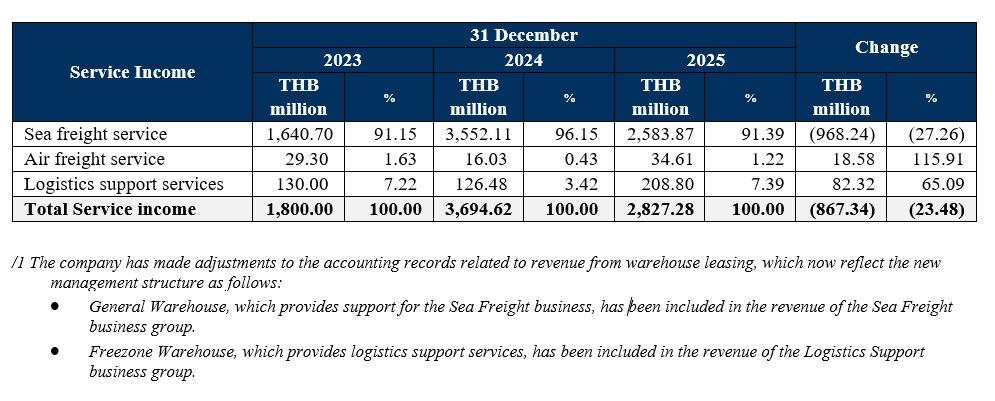
Under this context, the Company's service revenue in 2025 amounted to 2,827.28 million Baht, a decrease of 867.34 million Baht or 23.48% from the previous year. The primary reason for this was the decline in global freight rates, which impacted the Company's core business revenue. However, despite the overall revenue decrease in line with market conditions, the Company was able to maintain an appropriate level of operational performance, achieving a gross profit of 439.41 million Baht and a net profit of 63.63 million Baht. This reflects the efficiency in cost management and the ability to adapt under volatile market conditions.
The Company's main revenue continues to be derived from international sea freight forwarding services (Sea Freight), accounting for approximately 91.39% of total service revenue. However, the Company continuously expands and develops other logistics-related businesses to diversify revenue streams and add value to its services, including:
Air Freight forwarding services business, which has shown significant growth through the expansion of operations via a subsidiary providing air transportation services.
Logistics Support services business, which includes Free Zone warehousing services and other logistics services, with an expanding customer base and the development of increasingly value-added services.
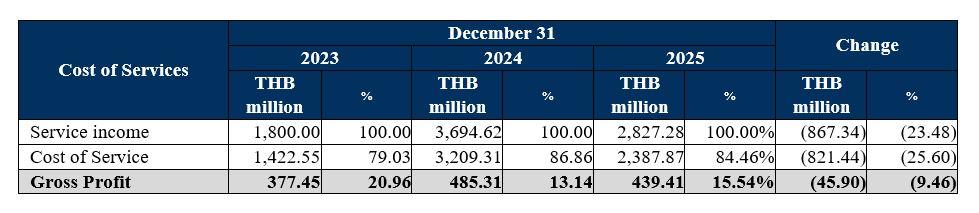
Regarding cost structure, the Company incurred service costs of 2,387.87 million Baht, a decrease from the previous year in line with revenue levels and freight rate trends. This resulted in the Company's gross profit margin for 2025 being 15.54%, an increase from 13.14% in 2024, reflecting the Company's ability to manage costs and restructure revenue to increase the proportion of high-margin services.
Overall, despite 2025 being a year where the logistics industry faced volatile freight rates and global economic uncertainties, the Company consistently maintained stable operational performance. Concurrently, it implemented strategies for business diversification, expansion of value-added services, and development of service networks both domestically and internationally, to enhance competitiveness and support sustainable long-term growth.
Operating Results & Financial Condition
Operating Results & Profitability
Service Revenue
In 2025, the company's service revenue amounted to 2,827.28 million Baht, a decrease of 867.34 million Baht or 23.48% from the previous year. This decline was primarily due to a reduction in revenue from the Sea Freight business, which was affected by the decrease in global freight rates compared to the high levels in 2024, influenced by geopolitical instability in the Middle East and rerouting of vessels through the Red Sea. Nevertheless, the company has maintained an appropriate level of service revenue amidst volatile market conditions. The company's service revenue can be categorized by service type as follows:
Sea Freight Business
The Sea Freight business remains the company's primary revenue source. In 2025, the company generated 2,583.87 million Baht from this business, accounting for 91.39% of total service revenue, a decrease from the previous year. This was primarily due to a decline in global freight rates compared to 2024, a period when freight rates were high due to geopolitical factors and market capacity constraints. Despite the decrease in freight rates, the company has maintained an appropriate volume of cargo transportation by expanding its customer base in international markets, developing collaborations with agents and business partners in various regions, and efficiently managing vessel space.
Air Freight Business
In 2025, the company generated 34.61 million Baht in revenue from its Air Freight business, accounting for 1.22% of total service revenue, a significant increase from the previous year. This growth resulted from expanding operations through its subsidiary ASL, which provides air transportation services, enabling the company to offer more comprehensive multimodal freight services.
The development of the Air Freight business also enhances cross-selling opportunities between Sea Freight and Air Freight customers, and strengthens the company's capability to provide comprehensive logistics services to clients.
Logistics Support Services Business
The company generated 208.80 million Baht in revenue from its Logistics Support Services business, accounting for 7.39% of total service revenue. This revenue stream increased from the previous year due to the expansion of warehousing services and related logistics services, including Free Zone warehousing services and other logistics support services.
The growth of this business reflects the company's strategy to increase the proportion of revenue from high-value-added services with less volatility than international transportation businesses, which will enhance revenue stability and support the company's sustainable long-term growth.
Other Income
In 2025, the company's other income amounted to 15.07 million Baht, an increase of 9.75 million Baht or 183.27% from the previous year. This income primarily stemmed from gains on the disposal of non-core business assets, as well as returns from investments in certain financial instruments, which are considered non-recurring items. Structurally, the company's other income accounted for 0.53% of total revenue, remaining low compared to revenue from core business operations. This indicates that the company's revenue primarily originates from its core international logistics services business. The company continues to focus on generating revenue from its core business, with other income serving as supplementary revenue derived from the company's asset management and investments during certain periods.
Cost of Services
In 2025, the company's cost of services amounted to 2,387.87 million Baht, a decrease of 821.44 million Baht or 25.60% from the previous year. The primary reason for this was the reduction in costs related to Sea Freight services, which aligned with the downward trend of global freight rates compared to the high levels in 2024.
The company's cost of services primarily comprises expenses related to freight management, such as freight charges, container handling fees, service fees for shipping lines and agents, and other logistics operating expenses, which generally correlate with the level of service revenue.
The decrease in the cost of services in 2025 was therefore a direct result of reduced business activity and freight rates compared to the previous year. Nevertheless, the company continues to prioritize efficient cost management through optimizing vessel space, negotiating with shipping lines and business partners, and restructuring services to align with market conditions. Structurally, the company's cost of services in 2025 accounted for 84.46% of service revenue, a decrease from 86.86% in 2024, reflecting the company's cost management efficiency amidst volatile market conditions and contributing to an improved gross profit margin in 2025.
Gross Profit
In 2025, the company reported a gross profit of 439.41 million Baht, a decrease from the previous year, consistent with the decline in service revenue. However, the company's gross profit margin was 15.54%, an increase from 13.14% in 2024. This improvement in the gross profit margin was primarily due to efficient management of the cost of services, particularly costs related to the sea freight business, which decreased in line with global freight rates, as well as effective management of vessel space and associated operating costs.
Furthermore, the increased proportion of revenue from value-added services, such as the Air Freight business and Logistics Support services, contributed to the improvement in the company's gross profit margin during the year. Overall, despite the company's service revenue being affected by volatile freight market conditions, the company maintained efficient cost management, leading to an improved gross profit margin compared to the previous year.
Selling Expenses
In 2025, the company's selling expenses amounted to 134.18 million Baht, a decrease of 8.07 million Baht or 5.67% from the previous year. These expenses primarily consisted of sales commissions for employees and remuneration for sales agents, which are variable costs dependent on the company's service revenue.
The decrease in selling expenses in 2025 was consistent with the decline in revenue from the core business, particularly the Sea Freight business, which was affected by the decrease in global freight rates. This resulted in a reduction in commissions and other selling-related expenses in line with the level of business activity.
Nevertheless, the company continues to prioritize the development of sales channels and the continuous expansion of its customer base, particularly through extending collaborations with international partners and agents, as well as promoting value-added services such as Air Freight and logistics support services, to enhance long-term revenue growth opportunities.
Structurally, selling expenses in 2025 accounted for 4.75% of service revenue, which is comparable to the previous year, reflecting the management of selling expenses in line with the company's revenue levels and business structure.
Administrative Expenses
In 2025, the company's administrative expenses amounted to 232.36 million Baht, an increase of 25.86 million Baht or 12.52% from the previous year. This increase was primarily due to personnel expenses and costs associated with supporting the company's business expansion, as well as information technology and internal system expenses, aimed at enhancing operational efficiency and supporting long-term business development.
Furthermore, the company incurred expenses related to business network expansion and the development of international partnerships, which are part of its strategy to enhance competitive capabilities and support the future growth of the logistics business.
Structurally, administrative expenses in 2025 accounted for 8.22% of service revenue, an increase from 5.59% in 2024. This increase in proportion was partly due to the decrease in service revenue in 2025. Nevertheless, the company continues to prioritize prudent expense management to align with business growth strategies and maintain organizational operational efficiency.
Financial Costs
In 2025, the company's financial costs amounted to 11.72 million Baht, a decrease of 1.01 million Baht or 7.93% from the previous year. The majority of the company's financial costs are interest expenses on lease liabilities related to right-of-use assets, such as ISO tank containers and equipment used in logistics operations.
The decrease in financial costs in 2025 resulted from the gradual reduction of lease interest obligations over the contract term, as well as efficient management of lease agreements and related assets.
The company has no interest obligations from loans with financial institutions, resulting in a low financial cost structure and limited interest rate risk. This reflects the strength of its financial position and a cautious approach to capital structure management.
Structurally, the company's financial costs accounted for only 0.41% of total revenue, which is a low level and does not significantly impact the company's overall operating performance.
Net Profit
In 2025, the company's net profit amounted to 63.63 million Baht, a decrease of 23.96 million Baht or 27.35% from the previous year. The decline in net profit was primarily due to a reduction in revenue from the Sea Freight business, which is the company's core business, and was affected by the decrease in global freight rates compared to the high levels in 2024.
Nevertheless, the company efficiently managed its cost of services, leading to an improvement in its gross profit margin from 13.14% in 2024 to 15.54% in 2025. Furthermore, the growth of the Air Freight business and Logistics Support services contributed to diversifying the company's revenue structure.
The company's Net Profit Margin was 2.25%, a slight decrease from 2.37% in 2024, reflecting the impact of reduced revenue from its core business. Nevertheless, the company has maintained its profitability amidst volatile market conditions.
Overall, despite the company's performance in 2025 being pressured by a weaker global freight market, the company maintains an efficient cost structure and the ability to adapt to changes in the logistics industry. It continues to develop its business and expand value-added services to enhance competitive capabilities and support the company's long-term growth.
Profitability Ratios
For the year ended December 31, 2025, the company's Gross Profit Margin was 15.54%, an increase from 13.14% in 2024, despite a decrease in service revenue due to a weaker freight market compared to the previous year. Nevertheless, the improvement in the gross profit margin reflects efficient management of the cost of services, as well as a restructuring of revenue to include a higher proportion of high-margin services, such as the Air Freight business and logistics support services.
The Operating Profit Margin in 2025 was 3.11%, a slight decrease from 3.25% in 2024, primarily due to an increase in administrative expenses related to investments in personnel and systems to support long-term business expansion. Regarding the Net Profit Margin, the company's net profit margin was 2.25%, a decrease from 2.37% in 2024, reflecting the impact of reduced revenue from its core business. Nevertheless, the company has maintained its profitability amidst volatile market conditions.
For the Return on Equity (ROE), in 2025, it was 7.12%, a decrease from 9.53% in 2024, consistent with the decline in net profit during that year.
Meanwhile, the Return on Assets (ROA) in 2025 was 4.62%, a decrease from 6.10% in 2024, primarily due to a decline in net profit compared to the previous year.
Overall, despite the company's revenue being affected by the volatile global logistics market, the company has been able to maintain an appropriate level of profitability through efficient cost management and diversifying its revenue structure.
Operating Efficiency Ratios
As of December 31, 2025, the company's average Days Sales Outstanding (DSO) was 43 days, a decrease from 48 days in 2024, reflecting improved efficiency in managing trade receivables and collecting payments from customers, which enables the company to manage liquidity and working capital more effectively. Meanwhile, the average Days Payable Outstanding (DPO) in 2025 was 28 days, a slight decrease from 29 days in 2024. This change aligns with the level of business activity and the company's trade creditor structure. When considering the Cash Cycle, the company's cash cycle in 2025 was 23 days, a decrease from 28 days in 2024, indicating improved efficiency in the company's working capital management, as the company can convert sales revenue into cash more quickly.
Overall, the company continues to prioritize efficient working capital management through controlling collection periods and appropriately managing trade payables, thereby supporting financial liquidity and continuous business operations.
Financial Policy Analysis Ratios
As of 31 December 2025, the Company’s Debt to Equity Ratio (D/E) was 0.54 times, slightly increasing from 0.52 times in 2024. This reflects a still appropriate capital structure, with the Company maintaining a relatively low level of debt compared to shareholders’ equity. The majority of the Company’s liabilities consist of operating liabilities and lease liabilities related to the utilization of assets supporting its logistics operations. The Company does not have long-term borrowings from financial institutions, resulting in low exposure to interest burden and interest rate volatility.
The Interest Coverage Ratio for 2025 was 8.51 times, decreasing from 11.09 times in 2024, in line with the decline in operating profit during the year. Nevertheless, the ratio remains at a level that reflects the Company’s sufficient ability to service its interest obligations.
Overall, the Company continues to adopt a prudent financial policy, emphasizing the maintenance of an appropriate capital structure and effective liquidity management to support its business operations and future investment opportunities.
Liquidity & Capital Adequacy
Liquidity Ratios
For the year ended December 31, 2025, the Company's current ratio was 2.98 times, which is similar to the previous year. This ratio reflects the Company's ability to manage its current assets to adequately cover current liabilities. The change in the liquidity ratio over the past year resulted from adjustments in current assets and current liabilities in line with business conditions. In 2025, some current assets, such as cash and trade receivables, decreased in line with the reduced service revenue due to the freight market conditions. Meanwhile, the Company has continued to effectively manage its current liabilities and operating cash flow. As for the Quick Ratio in 2025, it was 1.78 times, which reflects the Company's ability to settle short-term debts with highly liquid assets, such as cash and trade receivables, without relying on the sale of other assets.
Meanwhile, the Cash Flow Liquidity Ratio in 2025 was 0.60 times, which improved from the previous year. This reflects an improved ability of operating cash flow to support current liabilities. Overall, the Company maintains an appropriate level of financial liquidity and can effectively support its business operations and short-term obligations.
Asset Management Capability
Assets
As of December 31, 2024, and December 31, 2025, the Company's total assets amounted to Baht 1,436.18 million and Baht 1,378.92 million, respectively. As of December 31, 2025, the Company's total assets decreased by Baht 57.26 million, or 3.99 percent from the end of 2024. The primary reasons for the decrease in total assets were (1) a decrease in cash and cash equivalents by Baht 48 million, (2) a decrease in trade and other receivables by Baht 102 million, mainly due to a reduction in freight rates despite overall work volume remaining relatively stable, coupled with more efficient debt collection management, and (3) a decrease in prepayments and other current assets in line with work volume. However, the Company experienced an increase in some significant asset items, such as other current financial assets, which increased by Baht 50 million.
Liabilities
As of December 31, 2024, and December 31, 2025, the Company's total liabilities amounted to Baht 517.31 million and Baht 484.71 million, respectively. As of December 31, 2025, the Company's total liabilities decreased by Baht 32.60 million, or 6.30 percent from the end of 2024. This was primarily due to current liabilities totaling Baht 339 million, a decrease of Baht 85 million or 20 percent from the previous year, mainly driven by (1) a decrease in trade and other current payables, consistent with reduced workload and freight costs, (2) a decrease in unearned revenue due to a slowdown in business activities, and (3) close management of short-term debt repayment and working capital rotation. Meanwhile, non-current liabilities totaled Baht 146 million, an increase of Baht 52 million or 56 percent from the previous year, mainly resulting from (1) an increase in lease liabilities due to expanded investment in right-of-use assets, and (2) long-term obligations related to the Company's business operations and investments.
Shareholders' Equity
As of December 31, 2024, and December 31, 2025, the Company's total shareholders' equity amounted to Baht 918.87 million and Baht 894.21 million, respectively. As of December 31, 2025, the Company's total shareholders' equity decreased by Baht 24.66 million, or a decrease of 2.68 percent from the end of 2024. This was primarily due to the interim dividend payment of Baht 95.00 million, while the Company recorded a net profit for the year of Baht 63.64 million, resulting in a decrease in net retained earnings compared to the previous year.
Overall, the Company maintains a strong financial structure with a low debt-to-equity ratio and possesses the ability to manage liquidity appropriately to support its business operations and future investments.
Debt Obligations & Off-Balance-Sheet Management
None
Material & Related-Party Transactions
None
Debt Securities with Financial Ratio Requirements
Debt Securities with Financial Ratio Requirements Issued?
No
Factors That May Affect Financial Condition
Factors or Incidents That May Materially Affect Financial Condition
1. Volatility of Freight Rates and Availability of Shipping Space
Freight rates and international trade volume. Freight rates depend on the global market's supply and demand conditions. including geopolitical factors and the management of shipping line capacity. Therefore, the Company aims to diversify routes, expand into new markets, and increase the proportion of value-added services such as ISO Tank and Logistics Support to reduce revenue volatility.
2. Impacts from Geopolitical Conflicts
Unrest in certain regions, such as tensions in the Middle East or the Red Sea route, may cause shipping lines to reroute, increasing transit times and costs. Concurrently, international trade tensions may affect global trade volumes during certain periods. The Company closely monitors the situation and manages relationships with multiple shipping lines to mitigate impacts on shipping space and costs.
3. Overall Economic Conditions of Key Trading Partner Countries
The economic conditions and interest rate trends in key trading partner countries, particularly the United States, may affect export volumes and the demand for logistics services. Despite short-term fluctuations, the recovery of global trade in the subsequent period remains a supporting factor in the medium term.
4. Exchange Rate Fluctuations
A portion of the Company's revenue and costs are denominated in foreign currencies, particularly US dollars. Exchange rate fluctuations may impact revenue, costs, and recognized profits in the financial statements. The Company manages this risk partly through forward foreign exchange contracts and by managing its revenue and expenditure structure in the same currency (Natural Hedge) to mitigate the impact of currency fluctuations.
5. Competition in the Logistics Industry
The logistics business is highly competitive, both from domestic and international operators. Therefore, the Company prioritizes developing service quality, expanding its network of business partners, and developing value-added services to enhance its competitiveness and retain its customer base in the long term.
Overall, the Company continues to monitor and assess various factors that may impact its business, while continuously adjusting strategies and operational guidelines to align with the changing business environment, thereby supporting the Company's sustainable growth in the future.
Projects or R&D Affecting Future Results
None
Other Projects or Research
| Title | Description |
|---|---|
| 4.2 Key Financial Information | The auditor's report from the audit of the Group's annual financial statements and the conclusions from the review of interim financial information can be summarized as follows:
Auditor EY Office Limited, Mr. Vorapoj Amnuaypanit /1 Certified Public Accountant, License No. 4640 Auditor's Opinion/Conclusion The auditor expressed an unqualified opinion in the auditor's report that the consolidated financial statements and the separate financial statements present the financial position as at December 31, 2023, the results of operations, and cash flows for the year then ended of Sino Logistics Corporation Public Company Limited and its subsidiaries, and of Sino Logistics Corporation Public Company Limited only, fairly in all material respects in accordance with financial reporting standards. Annual/Period For the year ended December 31, 2024 Auditor EY Office Limited, Mr. Vorapoj Amnuaypanit /1 Certified Public Accountant, License No. 4640 Auditor's Opinion/Conclusion The auditor expressed an unqualified opinion in the auditor's report that the consolidated financial statements and the separate financial statements present the financial position as at December 31, 2024, the results of operations, and cash flows for the year then ended of Sino Logistics Corporation Public Company Limited and its subsidiaries, and of Sino Logistics Corporation Public Company Limited only, fairly in all material respects in accordance with financial reporting standards. Annual/Period For the year ended December 31, 2025 Auditor EY Office Limited, Mr. Vorapoj Amnuaypanit /1 Certified Public Accountant, License No. 4640 Auditor's Opinion/Conclusion The auditor expressed an unqualified opinion in the auditor's report that the consolidated financial statements and the separate financial statements present the financial position as at December 31, 2025, the results of operations, and cash flows for the year then ended of Sino Logistics Corporation Public Company Limited and its subsidiaries, and of Sino Logistics Corporation Public Company Limited only, fairly in all material respects in accordance with financial reporting standards. Note: /1 Mr. Vorapoj Amnuaypanit, the certified public accountant authorized to audit the financial statements for the years ended December 31, 2023 and 2025, is an auditor approved by the SEC Office. |